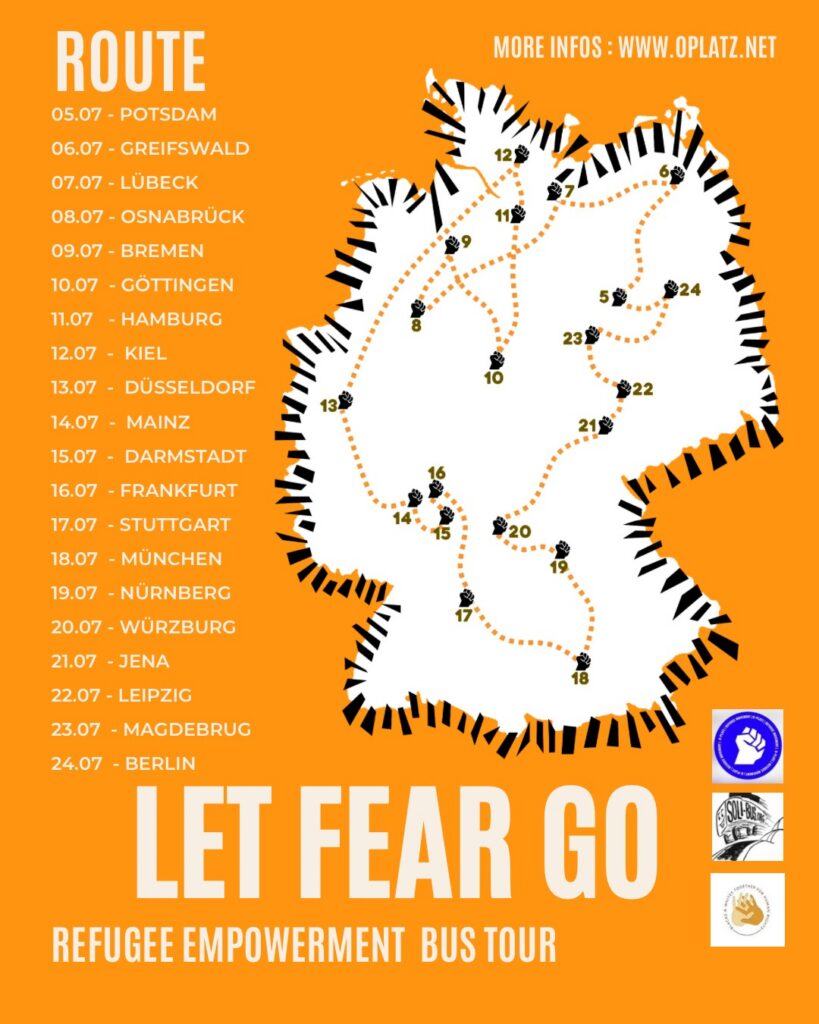
05.07.2026 Potsdam
On the first day of the LET FEAR GO refugee empowerment bus tour we drove to Potsdam. Arriving at “Refugee Emancipation solidarity” – a structure where refugees and citizen live together. Exchanging about the current situation and processes. Aferwards we connected with refugees living in a camp in the middle of an industrial area. A camp for families and single man. We shared drinks, cookies and stories. The Kids enjoyed painting and dancing as well as the adults.
Some of the refugees shared a dinner impressions and demands with us. Which was hold on Freiland Potsdam, a place Seebrucke Potsdam invited us in solidarity. We heard the difficulties of the life in the camp. A place, where people, also kids with special needs, live since years. Where different people and families need to share bathrooms. Where one need to leave their private space, also in the middle of the night, also the little ones, to go to the toilette. While the repressive system is putting pressure constantly – situations between single persons and realities of families on small space can tense massively. An situation full of pressure in which persons get forced to life. Created prison like structures -we have to break free!
06.07.2026 Greifswald
We have just left Straze in Greifswald, a place where we met people who are actively connected to people on the move. We learned that there will be a caravan through Mecklenburg-Vorpommern from august 26th to september 3rd. Solidarity, Equality, Unity. The community organizing goes beyond that.We were inspired by people, who offer cooking, sewing and stitching workshops to open a room to share about experiences.
Now we are on our way to Lübeck, we leave very thankful and inspired. Also with new people on board!Join us! Wherever you want – we are happy to have you with us! Stronger together.
07.07.2026 Lübeck
Yesterday we arrived in Lübeck. Our first stops were at two different camps. One again in an industrial compound next to the airport, the other a field filled with container. In both places we were expelled by the working staff. However we did not give up like that. In the evening we visited a third camp where we had the opportunity to talk to people and witness their stories. Again the vulnerable and sick are left behind. Despite them having the right to stay, they are forced to continue to live in this stressful conditions with shared bathrooms, because it is impossible to find a flat in Lübeck. #housingForAll
In the afternoon we learned the history of Lübecker Flüchtlingsforum and Solizentrum. The first exists since the deadly attack on a refugee camp in Hafenstraße 1996, where 10 people lost their lives and 39 more people where injured. The Solizentrum has existed since 2015, when ten thousands of refugees passed through the city to continue to scandinavia.
08.07.2026 Osnabrück
Yesterday we arrived in Bramsche Hesepe. We meet another group, after installing our materials: flyers,tables ..we went around the Bramsche-Hesepe’s camp of course not inside as usual they can’t let us be in camp because they pretend that we need an appointment. However we have exchanged with some refugees who are very angry: They complain about the food, the violence of the security guards, they are suffocated in the rooms (8 people per room all nationalities) and as a result living together is not easy at all because each country has its own culture.
Regarding Dublin, all Dublin ticket holders are required to sleep in their assigned room until they are removed from the premises by police. To ensure compliance with this requirement, checks are carried out morning and evening to verify that individuals have indeed slept in their rooms.There were some refugees who wanted to join the bus tour. One of them finally couldn’t because of his Dublin’s situation and the 3 others have promised to come and they also have information about the departure’s time. We left Bramsche- Hesepe at 6:00pm to Osnabrück, Hannoversche where we have a delicious dinner with the entire team.
09.07.2026 Bremen
Yesterday we were warmly hosted in Bremen at Altes Sportamt who showed a lot solidarity with our struggle. Although the German state, companies and securities did not want us to reach people in all 4 camps we visited. We were still able to talk and exchange with several people, with whom we shared our experiences. They described their conditions as difficult.
At all the camps we visited, there were only a few people left. At one camp in Bremen-West, only 50 people were left from the former 1200 people (capacity was only for 800). This is the reaction of the new GEAS law that already was planned years ago but is implemented now. The European borders are closed and people from the camps are moved away or deported. A Red Cross worker told us that Germany is pushing the racist and nationalist European law to another extent. With this strategy, Germany is responsible for deaths not only in the Mediterranean Sea but also in large areas of Central and Northern Africa as people are push-backed there already now.
Our tour is growing, we are getting stronger and we will fight until everybody is free.
10.07.2026 Göttingen
Today, north of Göttingen, we visited a huge camp that’s isolated and surrounded by right-wingers. There, wonderful people from Göttingen handed out food. Together with people from the camp, a local group organized a rally in front of the camp. There were moving speeches, colorful banners, and plenty of sunshine We’ve criticized the fascist European border regime as well as the German state’s complicity in murder. After a musical ride back, we were once again treated to a delicious meal in Göttingen. There was a great evening program there, featuring personal exchanges, ideas, and inspiration from past bus tours.
11.07.2026 Hamburg
After an intense and strong day of exchange the LetFearGo Tour spend in Hamburg – the bus is already around Kiel. The NINA – Frauen in Aktion collective welcomed us in Hamburg at M1 for an full day of exchange, book reading, movie screenings, shared food and discussions – surly with some dancing along. While there was also individuals from Lampedusa Hamburg, Soli Asyl, Soli Café and Alarm phone present we could share about the backlash and immense growing repression under GEAS, but als networks of strong resistance and building ties. Followed with an visit at the Lager “Schachthofstraße”, which is Iocated in Harburg – holding unacceptable conditions, a place where our brothers and sisters have to stay sometimes over years…
Complete lack of privacy, visitor ban, aggressive security – daily repression. The encounter at the camp was an harsh security which forced us away – avoiding us to connect. As we wouldn’t accept this situation, there was an spontaneous Anmeldung to demonstrate officially – after police encounter. Which involved into loud music, chants – short speeches and more detailed exchange with people staying around. As well as two people joining us from the spot for the tour. We are here and we will fight freedom of movement is everybody’s right.
12.07.2026 Kiel
In Kiel, we were warmly welcomed by the local group who organized a rally in front of the camp in Kiel. We played music, offered child games, maaany cake and had a lot of fun with many people. We exchanged, danced and shouted our our demands: no borders, no nations, stop deportations!
Later, we visited a Heim where we danced again, drank some coffee and had some deep talks. Further, we visited near that Heim an occupied tree as the area should be used for military services instead of social flats. In the evening, the Kiel crew cooked great food for us where we also had a short exchange.
Thanks a lot for this lovely and intense time.
13.07.2026 Düsseldorf
information will follow
14.07.2026 Mainz
Yesterday we received a warm welcome at the University Campus in Mainz. We were allowed to participate in a workshop on political prisoners in Russia, where we subsequently wrote letters to prisoners.
Afterwards we visited a camp and a home, both of which were already closed. We listened to the experiences of local groups.
In the evening, in addition to delicious food, there was an exchange room where we shared our experiences and learned from the participants.
15.07.2026 Darmstadt
Yesterday we experienced a diverse day with a visit to a camp near Mainz, where a resident approached us who had been there for three(!) years. She described her situation to us and shared her desire for an apartment.
Afterwards, we were in Darmstadt for the regular “prison earthquake,” a large and loud rally in front of the deportation prison. It was particularly moving that we were able to communicate directly with the prisoners. You asked for music and spoke to us via phone call directly over the speakers.
Finally, we sat with 40 people in a wonderful place. There we talk over delicious food, share thoughts and ideas, and exchange ideas about past and current struggles.
We thank the dear people of Mainz and Darmstadt for this day!
16.07.2026 Frankfurt
Today we visited Frankfurt and met with the Seebrücke collective at 12 pm at medico international. We had some getting to know each other and introducing each other before we started with the press conference at 2pm. A few journalists were present as well as some members of the Seebrücke collective and supporters. We introduced the Let Fear Go bus tour with a short video that has been prepared beforehand from migrantifa about the cities and lagers that we visited so far, moments shared in the bus, speeches held and photos showing the repression and personal stories that have been shared with us about the horrific conditions and circumstances withing the lagers. In the press conference Napuli was talking about the urgency and reason behind this bus tour. It was a very powerful conference where our comrades living in lagers – joined the bus tour shared their thoughts, demands and emotions.
Afterwards, we had lunch before meeting with project shelter. Where we had a warm welcome with a short introduction round following a presentation from project shelter about their collective and actions. Sharing a delicious dinner and some time for exchnges and more calm moments. At last, we introduced the bus tour in more detail and had a questions round – staying loud and clear : refugees are welcome here!
17.07.2026 Stuttgart
In Stuttgart we visited a camp in Ludwigsburg. We knew beforehand that it was more open than the ones weve seen so far during the tour – once we got there, prepared tables, snacks and music- a person who lives there shared positive experiences with us regarding the accomodation. Issues were discussed about missing financial support structurs. It was very nice to hear good things along the way. Families have their own apartment there instead of one tiny room, it is a quite surrounding with lots of green around and a garden in the back. Afterwards, we invited him and his family to join us for dinner in Stuttgart where we had a very warm welcome from Prisma. We had a tour around, an introduction round where we got to know all the different structures existing within Prisma such as a Legal Cafe, Language Cafe and AQA and many different initiatives. We learned and heard a lot from the Afghan Youth Structure, Kurdish Resistance and Migrantifa Stuttgart. It was a very impressive and empowering exchange.
Thank you – until the next!
As well we took time to watch together for impression of our exchange and discussion from Hamburg :
18. – 19.07.2026 München
Bellevue di Monaco
Bellevue di Monaco, located at Müllerstraße 2 is a city funded association with nonprofit status that operates since 2015, in tandem with its apartments where young people(18-27) stay during their vocational training, the section housing families, a „normal“ cafe, and the social center for refugees. Although most of the staff (around 500 people) are volunteers, there are also paid employees; the social center offers a wide range of activities, from German language courses to asylum counseling, and from Arabic lessons to football and boxing. Gender roles were visible in the atmosphere but many women were talking about that they are challenging the patriarchal roles in the space.
Visit to the Ankerzentrum
The camp we visited as a group of seven or eight people looked ordinary from the outside, but inside it was a massive structure spread across three separate sections. We set up tables right in front of the camp, put out our drinks, food, and informational materials (Bellevue di Monaco, Let Fear Go), and turned on the music box. Although the camp residents were generally a bit hesitant since they didn’t know us but still curious, so we were able to talk to quite a lot of people.
According to what they told us, the conditions weren’t too bad: they had almost no complaints about security or social workers, and the food varied from day to day. Three meals were served, each in three-hour time frames; there was no kitchen. They could stay maximum 3 nights outside the camp; after that, the check-out would happen. The rooms were generally clean, accommodating two or three people each, and there was also a family section—we didn’t hear any serious complaints aside from the elevator having been out of order for months. However, when conflicts arose among the residents, the only penalty security imposed was a five-hour suspension. We handed out brochures to those unfamiliar with Bellevue di Monaco; but many people knew it already. And at least 3 people was interested to join the bus tour, at least for few days.
Generally, people spoke cautiously, without going into too much detail; English, Arabic, Swahili, and a little German could be heard in the talks. A few people asked about our objectives, which group we were working with, and where we would publish the reports we were collecting; however, the answers we gave were not very satisfying.
Two camp staff members (one chef and one security) came over and asked us to move the tables about one meter outside the camp’s boundary. We did so, and the matter was settled—though the interest they showed while reading our materials showed a nervousness as they tried to understand what we were doing.
The police also stood in the corner and told us if AfD shows up we can approach them, it was an interesting talk for sure; half an hour later, they returned and asked for a contact person, noting that they were aware this was not an official rally, because it is less than 50 people without megaphones. And one of us volunteered, and their data was in the end given—but at least, we weren’t directly forced to register.
Later we packed up and moved to the Infoladen of a Hausprojekt, where we found a corner to sleep.
19.07.2026
Today, after a long tour of intense 2 weeks, was a day for us to rest a bit, recharge, do our laundry, and clean the truck. After breakfast and our internal meetings, we left the infoladen where we were staying and went to “The TENT,” a place operated by the city of Munich since 1972 (but currently facing the threat of cuts to their financing!) where especially young people can stay for a low cost. Even though it looked like an ordinary hostel in a green field, you could see left-wing stickers and posters everywhere; and there was generally a friendly (and left-wing) atmosphere.
There, we had informal conversations and exchanged information, ideas and contacts with many people; but especially with activists from city of Rosenheim and Seebrücke Munich, as well as with a Munich city employee who works on migration and accomodation issues. We felt very welcome and right at home there—we’d like to thank everyone again for the friendly talks and the support! Later that night, we settled in to sleep under a massive tent alongside hundreds of other people.
20.07.26, Nürnberg
The area around the Heim and the entrance were very quiet; we could go inside and talk to people. Inside, massive and numerous signs warning against cigarettes, hookahs, drugs, knives, etc., caught our attention. Once inside, we spoke with two social workers. We learned that 150 people were staying there, that it would close in November 2026, and that the Red Cross was the operating organization (Träger). And the reason of closure was that there weren’t enough refugees staying. They wanted to distribute the refugees to rural areas who were staying in that Heim. It was actually a capitalist logic, because the operating organizations weren’t making enough money off the refugees. And, of course, people will be affected by the closure; many people work in Nürnberg, attend school and language classes, and use health services. In rural areas, however, they will be isolated and deprived of these opportunities.
Social workers are also affected by this; even though they’ll be working under the Red Cross, they don’t know where they’ll be “transferred” to—in a way, they’re sharing the refugees’ fate.
However, since there weren’t many people inside or around the shelter, and we thought we might encounter more people, we went to the Ankerzentrum.
Ankerzentrum:
It was definitely very different from the Heim; it looked like a prison, with high fences and even fences on the balconies—perhaps to prevent people from throwing things outside or committing suicide. Security checks were strict—the complete opposite of the Heim. When we asked if we could go inside, the security guard told us we could enter with an “Anmeldung” after obtaining permission from the Diakonie in the city. He was definitely stressed; he basically told us to go far away—to the train station—and set up a table somewhere far. He was filled with fear and anxiety, and a controlled anger; he even added that he might lose his job because of us. Actually, he wasn’t any different from the staff at the Ankerzentrum in Munich—he, too, was afraid and worried about potential decisions from chefs and his superiors. Afterward, we went to an empty area just outside the camp, but we were chased away again by security there, and one of us was even told, “Go back to your home country.” To avoid causing any more stress, we crossed to the other side of the road and set up our tables there.
Still, we were able to exchange information about camp conditions with many camp residents passing by. For example, we learned that they’re given a white piece of paper for entry and exit, that it’s physically processed, that they can’t leave without handing it in, and that in exchange, they receive a number. They can stay outside for 5–6 days; after that, they’re deregistered (Abmeldung). And there’s a ban on visitors, like all initial reception centers. On average, about three people stay in the rooms—there are both families and individuals. The food is generally bad, but the kitchens allow you to cook your own meals. They also mentioned that there is no internet or there are constant connection problems. Another issue, as is common in many camps, is that residents often have conflicts with one another.
Meanwhile, the security guards called the police during these talks, so the police arrived. The police asked us what we were doing there; we explained that we had come from Berlin, were on a tour visiting the camps, and wanted to talk to the refugees. They asked about our purpose, who had written the slogans on the sidewalks with chalk (“Refugees Welcome,” “Fuck AfD,” “Let Fear Go”), and how long we planned to stay. They told us that what we were doing was technically a crime but that they wouldn’t cause any trouble—as long as we left the area clean. It was also interesting that some of us were asked questions about who was a “real Berliner.” They only asked the „white Germans“ among us—asking where they were from and where they were originally from, as if it were small talk. It was definitely an interesting conversation. The police were a bit curious, but at the same time, they also wanted to discipline and keep the leftists from Berlin in line. They left after warning us that if we didn’t leave the place clean, the contact person (Ansprechperson) would face a fine. After few hours we slowly continued on our way toward Jena.
21.07.2026 Jena
Reflection Round after breakfast, we gathered for a reflection round; during this time, in addition to topics such as respect, boundaries, and division of labor, we also discussed moments when we sometimes failed to understand one another, our communication and behavior ways, and our responsibility toward the community. Perhaps we should repeat a session like this more often.
First Heim – at the gathering in front of the Heim—organized and largely prepared by Oma Gegen Rechts—we spent time with the camp residents and Oma Gegen Rechts activists, playing badminton, ball games; drinking coffee, tea, and lemonade; and eating sweet and savory pastries. Despite the rain, an exchange took place, though it was more of a social gathering than a deep exchange of information and ideas. However, from what we learned, people were staying in the rooms in pairs; some were families, others were living alone. There is no obligation checking in after some days, and people generally seemed content with their situation, though bureaucratic issues persisted, and rejection decisions continued to arrive. Conversations were generally in German, Arabic, English, and a bit of Somali.
Around 3pm, the police arrived the second time and told us that the green space where we were staying was private property and that the building’s owner wants us to leave. As a result, we packed up our things and moved on to the next Heim.
The Second Heim – when we arrived here, we encountered families and children; there was no social worker or security at the entrance, so we went straight inside, knocked on the doors of the rooms, and were able to visit people and invite them downstairs. The place looked generally clean; as we entered the communal kitchens and knocked on doors, people came out and joined us. They complained about the rooms being excessively hot and, in particular, about the overcrowding in case they are big families.
Just outside the Heim, we set up tables, brought out food and drinks again, and hung up banners. For a while, we played music and danced, ate and drank, chatted, and played ball and badminton; even though we couldn’t have in-depth conversations about camp and asylum conditions here, we had a good time together.
After our second camp visit, we moved on to the Polaris Youth Center. There, we first ate the meals prepared by the activists together and had informal conversations with people from different groups and backgrounds throughout the meal. Then, about 30 of us gathered to form a circle; in this circle, refugees—both activists and non-activists—, non-refugee migrants, activists from Jena Seebrücke, Omas Gegen Rechts, and ROSA (Rolling Safe Space), and us—the activists from the bus tour—stood side by side. English, German, Turkish, Arabic and French could be heard during the discussion. Around 10pm, we headed back to our sleeping place.
22.07.2026 Leipzig
When we arrived at the camp in Leipzig around 1pm, a well-organized group of refugee and non-refugee activists greeted us; there were already about 20 people in front of the camp, and that number later grew to about 50. Tables had been set up, banners hung, informational materials laid out, and they were unloading the food they’d prepared from the cars. Usually, when we arrive at the camp, the area is empty, and we set everything up ourselves, but this time it was interesting to arrive as a sort of “guest.”
From what we learned, an activist group visits that camp (but also other camps sometimes) almost every week, and generally, the activists maintained a good relationship and cooperation with the camp management. However, despite the good relationship, the police insisted that the event be officially registered an threatened to give a fine.
Meanwhile in addition to the banners already on-site, new ones were painted; hair was cut; people played with balls; music from different regions was played and people danced; children participated in various activities; and people engaged in informal conversations and exchanged information with one another.
As we learned the rooms at the camp accommodated between 4 and 20 people; in this regard, we learned that the lack of private space was a major problem. There is no kitchen, and it’s forbidden to take the prepared food upstairs to the rooms, meaning if they aren’t hungry at that moment, they can’t eat it later. Some people do the 80-cent jobs (cleaning, cooking, translation), while others do not. Camp residents can stay outside for a maximum of 3 days; if they exceed that, they are de-registered. There are also complaints that the toilets are not clean. Although there are occasional issues with security, relations with social workers are good—at least for some refugees!
Around 5pm, we gathered and set off as a fairly large group by bus toward an area called Ostwache; and a police car followed us the whole way!
Ostwache:
When we arrived there, everything was again very well-organized. Tables and chairs had been set up, and people were chopping and frying vegetables. From what we learned, Ostwache used to be an old fire station; it’s now used as a community center. It currently operates under an association; on one side, there’s the bicycle community workshop, where people can repair their bikes with help from others. In the entrance area on the other side, various (info-) events are held. A flea market is also set up from time to time in the empty space in the middle. The property belongs to the city, but its future status is uncertain; while the people who use the space want to convert it into an NGO and continue operating it, it is also under threat of privatization.
After playing some music, playing with balls, and having informal conversations for a while, we moved to the indoor section. There, after showing a video about our bus tour, we briefly explained our goals and political perspectives, such as building relationships with refugees and activists, coming together, empowering ourselves, and that we aim to stop deportations, and abolish borders and camps. The groups from Leipzig shared that there will be a protest next week 28th of July from 6pm at Halle Leipzig airport to oppose the mass deportation to Afghanistan. After a few more announcements and slogans, we moved on to dinner! After a delicious dinner, we continued with music and dancing or sitting around the fire bin. At around 10.30pm, we headed back to the places we sleep.
23.07.2026 Magdeburg
After Leipzig we headed toward an isolated camp in Magdeburg’s industrial district. On the way, since the state elections in Saxony-Anhalt were approaching, we saw plenty of AfD campaign posters, including the following:
„Wieder sagen wie man denkt
Tanken statt tränen
Nieder mit Windrädern
Abschieben ab Minute 1
Die fleissigen Belohnen”
The “right” to use discriminatory language, anti-environmentalism, xenophobia, and “asocial” stigmatization had found their way into this far-right party’s election propaganda.
When we arrived at the camp around 2pm, local refugee and non-refugee activists had set up tables, laid out food and drinks, and placed informational materials and T-shirts with political messages on the tables. Since it was a registered event, there was a heavy police presence; and as we learned, the police had initially arrived with 10 police cars based on false intelligence that the “far left” was planning to enter the camp. However, they generally didn’t cause any stress.
Just like during our other visits, we set up our tables, brought out the speaker, listened to plenty of music, danced, and had informal chats. We wrote our political messages in different languages (English, German, Kurdish, Farsi, Somali) on the ground with chalk (freedom of movement, woman life freedom, freedom bread work, no one is illegal…). In addition, one of us took the microphone to talk about the goals of the bus tour and called on everyone to both strengthen the struggle and join the bus tour. Our visit in front of the camp ended with an amazing rap performance by a camp resident.
“Knast”, Youth Center:
Around 5pm, we moved on to a youth center. In 1990, local punks occupied a closed Stasi prison, and through agreements with both the city and the church, they were granted the right to use it as a youth center that same year—hence the name “Knast.”
There, one group had taken the initiative to print T-shirts, while another was cooking. Others were gathered in small groups—some playing table tennis, some playing soccer, and some doing pull-ups. Some were doing their makeup, while others were stringing beads to make bracelets.
Around 8pm, after an amazing dinner, we gathered again, and people from our group, activists from Magdeburg as well as the Hamburg-based “Women in Action” and an Afghan women’s refugee initiative active in Saxony-Anhalt, shared their struggles and perspectives. Around 9pm, we wrapped up and headed to our sleeping place where we continued our exchange around the big fire bin.
24.07.2026 Berlin
After a sunny breakfast in our hosts’ courtyard we entered our bus a last time to reach our final destination Berlin Oranienplatz.
Two and a half hours later we emerged chanting slogans and holding up banners. We were welcomed by a small group who already prepared the infrastructure of the day. Together we continued setting up tables, benches and pavilion. Our truck was decorated and served as a stage. More and more people arrived. Info tables were filled with material. The group against Bezahlkarte offered a coupon exchange. Frauen machen Druck brought beautiful linol prints. Migrantifa Berlin was present with infos and snacks.
Who else had an info table?
At 3pm the stage program started. There was space for all the groups in attendance to present their work. Afterwards the refugee activists who participated in the tour shared their experiences. More of these speeches we will share publicly another time.
The event concluded with music and dancing. At 9.30 pm we packed while the Dyke* march arrived at the square. Also there, an activist from Nina (women in action- Hamburg) gave a powerful speech and the whole group chanted “Kein Mensch ist illegal, Bleiberecht überall”
(no one is illegal, right to stay everywhere)